
Latest Blogs
16
Jul
July 16, 2026
Agriculture has always faced uncertainty, but today’s growers are navigating a unique combination of challenges. Drought, rising production costs, changing weather patterns, labour shortages and global instability are all affecting how farms operate and plan for the future.
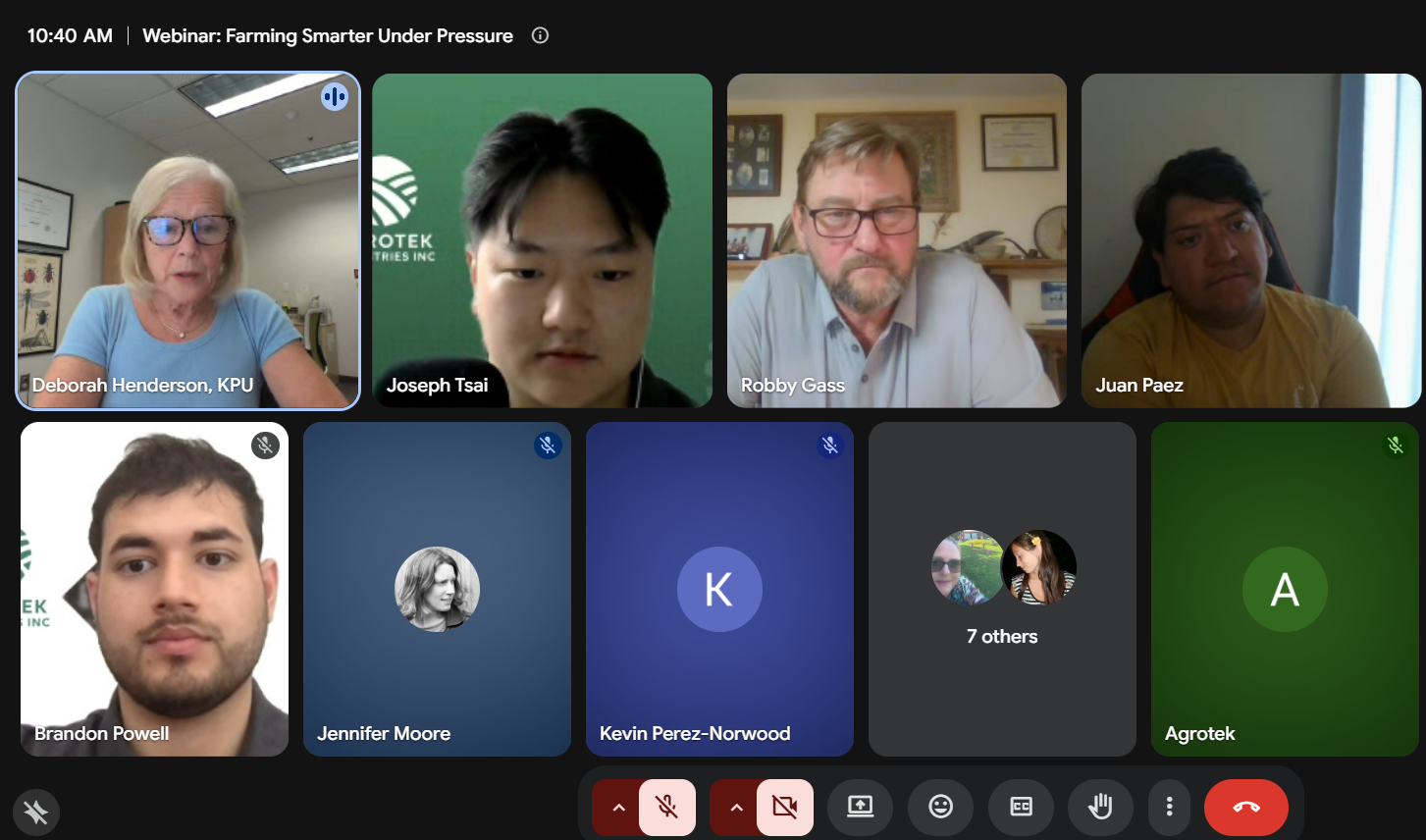
To explore these issues, Agrotek recently brought together Juan Paez of Wild Flight Farm, Robby Gass of ALBA Organics, and Dr. Deborah Henderson from the Institute for Sustainable Horticulture at Kwantlen Polytechnic University.
What followed wasn’t a conversation about one product or one farming practice, it was a discussion about how healthier soils, practical management, research and technology all play a role in helping farms adapt to an increasingly unpredictable future.
One of the strongest themes throughout the discussion was the importance of organic matter.
Drawing from his experience at Wild Flight Farm, Juan explained that fields with higher organic matter consistently perform better under difficult conditions. Healthier soils retain water more effectively during dry periods, improve drainage after heavy rainfall and create a stronger environment for root development.
“We’re seeing that plots with higher organic matter are more resilient.” — Juan Paez
Robby reinforced that message, describing organic matter as the foundation of resilient farming.
“Building organic matter is fundamentally the most important action a farmer can take.” — Robby Gass
Dr. Deborah Henderson added the research perspective, explaining that scientists are placing increasing attention on the biological side of soil health. Rather than looking only at nutrients, researchers are also studying microbial activity and biological indicators that help explain why some soils are naturally more resilient than others.
Together, their perspectives painted a clear picture: healthy soils don’t happen overnight, but they are one of the best long-term investments growers can make.
Improving soil health isn’t only about what goes into the soil—it’s also about how the soil is managed.
Juan shared how Wild Flight Farm has changed several cultivation practices over the past few years, reducing aggressive tillage, investing in cover crops and adapting irrigation practices to improve soil structure while reducing compaction.
Robby expanded on that idea, explaining how repeated cultivation can create compacted layers beneath the soil surface, making it harder for roots to access both water and nutrients.
The discussion also challenged the common belief that applying more fertilizer automatically leads to healthier crops. Instead, the panel emphasized that soil biology plays a critical role in making nutrients available to plants.
Dr. Henderson illustrated this with a simple analogy:
“When you give the plant everything it needs, it’s like living beside a McDonald’s. You never learn how to cook.” — Dr. Deborah Henderson
Her point was that healthy soils rely on complex biological relationships. While fertilizers certainly have an important place in agriculture, long-term resilience depends on maintaining the living systems that naturally cycle nutrients and support plant growth.
The conversation then shifted from soil to technology.
Dr. Henderson highlighted how quickly innovation is moving across agriculture, from sensors and automation to robotics and biological products. At the same time, she noted that growers face an increasing challenge: deciding which technologies truly deliver value.
Many of the projects at KPU involve helping companies validate new agricultural technologies under real farming conditions, giving growers more confidence before investing in new tools.
She also introduced a challenge many growers may not have considered: “dashboard fatigue.” As more technologies enter the market, farms often end up managing multiple platforms that don’t communicate with one another, making it harder—not easier—to make decisions.
Juan agreed that technology adoption remains difficult for many growers, particularly when new equipment requires significant investment, training and changes to existing farming practices.
Robby offered another practical reminder: while biological products continue to evolve, nature rarely responds to a single solution. Instead of relying on isolated microbial products, he encouraged growers to think about supporting the entire soil ecosystem and allowing natural biological communities to do the work they were designed to do.
While each speaker brought a different perspective—as a grower, consultant and researcher—they consistently returned to one idea: agriculture’s biggest challenges cannot be solved by one person, one company or one technology alone.
Growers bring practical experience from the field.
Researchers help validate new ideas and technologies.
Industry develops tools that support better farming practices.
Governments play an important role in maintaining the infrastructure that agriculture depends on.
As climate, markets and production continue to evolve, conversations like these help bridge the gap between research and practice, giving growers practical ideas they can apply to their own operations.
Agrotek would like to thank Juan Paez, Robby Gass and Dr. Deborah Henderson for sharing their knowledge and experience, and everyone who joined us for the discussion.
This webinar is part of Agrotek’s webinar series, bringing together growers, researchers and industry leaders for real conversations about the challenges and opportunities shaping agriculture today.
Interested in learning more about how Agrotek can revolutionize your
farming practices? Get in
touch with us today!